
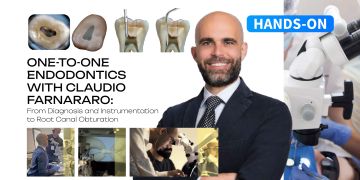
One-to-One Endodontics with Claudio Farnararo: From Diagnosis and Instrumentation to Root Canal Obturation


Програма
Endodontic treatment requires more than technical precision — it requires the ability to diagnose each case correctly, anticipate anatomical challenges and select the most appropriate approach at every stage.
This intensive three-day theoretical and practical course with Dr. Claudio Farnararo combines essential biological principles with hands-on training to help you refine your endodontic technique, from diagnosis and access cavity preparation to canal shaping and obturation.
Through a structured “do and learn” approach, you will practise on extracted teeth under the instructor’s continuous supervision, receive individual feedback and evaluate your results under the microscope and through radiographic assessment.
During the theoretical part, you will learn about:
— Indications for endodontic treatment, pulp pathology and the biological principles of the pulp–dentin complex
— Clinical diagnosis, endodontic radiology and the use of CBCT in treatment planning
— Access cavity preparation, endodontic anatomy and the use of ultrasonic tips
— Nickel–titanium instruments, modern alloys, working length determination and glide path preparation
— Root canal shaping techniques, including minimally invasive preparations and reduced-taper approaches
— Modern irrigation protocols, irrigant activation and the biological principles of root canal obturation
— Different obturation techniques, including warm vertical compaction, continuous-wave obturation, carrier-based systems and bioceramic sealers
— Management of teeth with wide or open apices, apexification and apexogenesis.
During the hands-on sessions, you will perform:
— Access cavity preparation in incisors, premolars and molars, with microscopic evaluation and individual feedback from the instructor
— Manual canal scouting and manual and mechanical glide path preparation
— Root canal shaping using different instrumentation systems, including the option to work with your preferred system by prior agreement with the instructor
— Root canal obturation using different filling techniques
— Radiographic assessment of completed obturations and discussion of clinical cases and treatment outcomes.
With only 2–4 participants, the course offers a highly personalised learning experience tailored to your skills and educational objectives. Continuous interaction with Dr. Farnararo allows you to refine your technique, address individual challenges and receive immediate feedback throughout the practical sessions.
The goal is to help you develop a clear, efficient and reproducible endodontic workflow — enabling you to make informed clinical decisions, preserve healthy dental tissue and apply the techniques learned directly in everyday practice.
Program
Day 1
Theoretical part — Diagnosis, Treatment Planning and Access Cavity Preparation (09:30–13:30)
— Indications for endodontic treatment
— The pulp–dentin complex: structure and biological functions
— Pulpal pathologies and their clinical implications
— Management of endodontic emergencies
— Clinical diagnosis and endodontic radiology
— CBCT in endodontics and its role in treatment planning
— The use of local anaesthetics in endodontics
— Isolation of the operative field
— Pre-endodontic treatment and tooth reconstruction
— Endodontic anatomy and root canal morphology
— Access cavity preparation and the use of ultrasonic tips
— Locating root canal orifices
— Analysis and discussion of access cavities prepared by participants.
Hands-On — Access Cavity Preparation (Hands-on training on extracted teeth)
— Access cavity preparation in incisors, premolars and molars
— Individual supervision and correction of each participant’s technique
— Microscopic evaluation of prepared access cavities, with feedback from the instructor.
Day 2
Theoretical part — Root Canal Instrumentation and Shaping (09:30–13:30)
— Biological and mechanical principles of root canal shaping
— Classification of endodontic instruments
— Characteristics of nickel–titanium (NiTi) instruments
— Modern NiTi alloys and their clinical applications
— Prevention of instrument separation
— Endodontic motors: features, settings and clinical use
— Canal scouting and working length determination
— Electronic apex locators: principles and application
— Manual and mechanical glide path preparation
— Glide path management in complex cases
— Root canal shaping with modern rotary instrumentation systems
— Shaping strategies for minimally invasive preparations and reduced-taper techniques.
Hands-On — Canal Scouting, Glide Path and Root Canal Shaping (Hands-on training on previously accessed teeth)
— Manual canal scouting and initial negotiation of the root canal system
— Manual and mechanical glide path preparation
— Root canal shaping using different instrumentation systems
— Opportunity to work with the shaping system of the participant’s choice, provided it is agreed upon with the instructor in advance.
Day 3
Theoretical part — Irrigation, Obturation and Management of Open Apices (09:30–13:30)
— Magnification systems and the operating microscope: applications and advantages
— Modern root canal irrigation techniques
— Irrigation solutions and activation methods
— Biological principles of root canal obturation
— Root canal filling materials and instruments
— Warm vertical compaction of gutta-percha: indications and technique
— Continuous-wave obturation: down-pack and thermoplastic gutta-percha backfill
— Carrier-based obturation: indications and clinical techniques
— Obturation using modern bioceramic sealers
— Management of teeth with wide or open apices
— Apexification and apexogenesis.
Hands-On — Root Canal Obturation (Hands-on training on previously shaped teeth)
— Root canal obturation using different filling techniques
— Radiographic assessment of the completed obturations
— Review and discussion of clinical cases, including analysis of treatment outcomes.
Preparation Required for Participants
Participants are required to bring extracted teeth, including incisors, premolars and molars. Intact, non-sterilised teeth are preferred; third molars should be avoided. Teeth must be stored in saline solution and must not be placed in alcohol, sodium hypochlorite or other chemical solutions. Where possible, participants should also bring radiographs of the corresponding teeth.
Ендодонтія
Разом веселіше!
Знижки для груп учасників!
3
5 %
4-6
7.4 %
7+
10 %

Лектори 1

Graduated in Dentistry and Dental Prosthetics from the Faculty of Medicine and Surgery at the University of Florence in 2004.
Specialised in Oral and Maxillofacial Surgery at the University of Florence in 2007.
Completed advanced training in clinical and surgical endodontics through courses in Italy and abroad with leading international experts.
Contract Professor in the Advanced Endodontics Course at the Second University of Naples in 2015.
Lecturer in the Advanced Endodontics Course at the University of Naples Federico II in 2022–2023.
Lecturer in the Second-Level Master’s Programme in Implantology and Oral Pathology at the University of Campania “Luigi Vanvitelli” in Naples in 2022–2023.
Academic Coordinator of the annual Postgraduate Master’s Programme in Clinical Microscopic Endodontics and Endodontic Microsurgery at the Catholic University of Murcia (UCAM), held in Naples.
Member of the Fradeani Education team from 2020 to 2023.
Co-author of the chapter “Tools and Techniques for Whitening Non-vital Teeth” in Black & White: Multidisciplinary Caries Protocols, Whitening and Treatment of Dental Discolorations, published by Edra.
Speaker at national and international congresses since 2024.
Consultant to multinational companies on the development and refinement of endodontic equipment and materials.
Organiser of practical workshops and hands-on courses in Italy and internationally.
Participates in selected clinical practices in Campania and Tuscany, limiting his clinical activity to clinical and surgical micro-endodontics.
Місце проведення
ECAD Florence, at the practice of Dr. Stefano Gori, Via di Scandicci 116, Florence, Italy